Sunday, April 29, 2012

Down the Crapper

The BBC had an article recently revealing that, according to the latest census, nearly half of India's population do not have a toilet at home.

Yes, this is a horrible and disgusting fact.

But my first reaction was "Who didn't already know this!?"

In fact, this article led to a second article that kicked off with "Is anybody really surprised?"

No, we're not really surprised. If anything, we're surprised this is just now becoming news.

It's no secret that I'm not a big fan of toilets in India. Sure, there are all kinds of studies saying that defecating in the squat position is actually better for your body (something about cleaning you out faster and more thoroughly...don't actually read any of these studies if you want to sleep tonight), but I see no studies that say standing in other people's feces is good for the soul. Toilets in India are generally so filthy and rank that you're likely to catch something just being in the vicinity.

But it can get worse. And does.

Nearly half the population has no toilet of their own. Some use public toilets (which I just covered the perils of), but the majority (49.8%) "defecate in the open."

Now anyone that's watched Slumdog Millionaire has seen the outhouse-style buildings suspended above a river. Because why crap into a deep hole in the ground when you can crap into the water supply? (In Pune, I have seen a slum just downstream from the water treatment plant. Think on that for a minute.)

Not all of this goes on in a semi-private little outhouse, though. No, I have seen people pull down their pants by the side of a busy road and have at it. When walking down the road, you not only have to worry about dodging paan stains (red spit caused by something similar to chewing tobacco) and animal feces (buffalo, cow, dog, horse, goat...the list goes on), you also have to worry about stepping in human feces.

This article (the one not at all shocked by the statistics) posed the issue in a way I found very interesting:
Is the lack of toilets and preference for open defecation a cultural issue in a society where the habit actually perpetuates social oppression, as proved by the reduced but continued existence of low caste human scavengers and sweepers?
Another interesting finding: Sikh and Christian households had the highest access to improved sanitation, at over 70%, while Hindus had the least access at 45%.

I can't help but notice that Hindus follow a strict caste system, while Sikhs have a much less severe caste system (and many don't believe in one at all) and Christians lack one altogether. India is made up of approximately 80% Hindus.

Is this sanitation issue one of many ways of reinforcing the caste system? While I seriously doubt it is a thought-out intentional plan for the government to oppress lower castes by not extending sanitation systems, it is entirely believable that it may be the subconscious reason behind the failure.

In a country so eager to move up in the world, one would think basic sanitation would be an issue they'd eagerly tackle. It is difficult, after all, to be taken seriously while baring your butt on the side of the road.

Thursday, April 5, 2012

I'm Still Here!

I realize it's been over a month since my last post.

That was not intentional.

As it turns out, my day-to-day life is B-O-R-I-N-G, leaving me without much to write about.

And also, I'm a slacker. So there's that.

Right now I'm in the midst of Spring Cleaning, which, for those of you unfamiliar, is the process of systematically ripping apart your home in order to clean each and every inch of it thoroughly.

Imagine emptying closets and scrubbing everything down. Pulling stationary appliances like refrigerators and stoves away from the wall to clean the unreachable sides and the floor underneath. Washing things you try to avoid thinking about the rest of the year, like windows and vertical blinds. Washing walls. I'm tired just making this list.

So expect a little more silence from me until I get through this task (or just give up...) but then I promise to be back with some actual interesting material.

In the meantime, I leave you in a era when ad jingles were catchy:

Thursday, March 1, 2012

I Wish I'd Known

A friend asked me what she should tell someone going to India for the first time. As I thought over what kind of information I should give her, I realized there are so many things I wish I'd been told before my first trip to India. Make or break kinds of things. I now understand that hubby did the best he could; viewing your home through a foreigner's eyes for the first time is difficult. Even after three visits he still struggles to foresee the impact something might have on me. But he's getting better.

Anyway, without further ado, and in no particular order (meaning read the whole thing), I present to you a list of "the shit I wish I'd known."

1) Whatever you think the weather will be, it won't. If you think it will be cold, it will be 90 degrees. If you think it will be hot, it will be in the 50s. India thrives on defying your expectations. Weather is just one of many ways.

2) The clothing you would take to travel pretty much anywhere else is completely useless in India. I wear jeans all of the time, so I took them to India. They became stretched out in a matter of minutes and never returned to normal size. I took long shorts, thinking surely knee length would be conservative enough in hot weather. Wrong. I even had a few sleeveless shirts, though not tank tops. Good enough, right? Nuh uh. The less white skin on display, the better. Now when I go there, if I could get my hands on a burqa I would wear it. Though young women are beginning to wear more and more western clothes (and more and more revealing clothes), a good rule of thumb is to dress two or three times more conservatively than they are. It just makes life easier. Nothing that shows any amount of leg, short sleeves are mostly ok, and never ever anything that showcases your chest or butt even just a little.

3) Your shoes will be destroyed; don't wear anything you actually like. See next point:

4) India is hella dusty. Unlike anything I've ever seen before. I've been behind trucks carrying a load of dirt that's just blowing right off the back and still never seen as much dust and dirt as there is in India. And there is trash all over the ground and people spit, pee and poop right where you're walking. Your feet will be permanently dirty. Black dirty. You won't even recognize your feet at the end of the day. And whatever shoes you were wearing will be the same way. You have to leave your shoes at the door anyway, so who cares how cheap and ugly they are? I have twice now thrown shoes in the trash after wearing them in India. It's just easier.

5) Poverty is in your face. This isn't a Sally Struthers infomercial. This is walking down the street outside an expensive American chain store and passing a family living beside the road in a tent constructed of tattered cloth collected from the garbage with their clearly malnourished naked two year old playing in the dirt and the wife washing clothes in the gutter. It will break your heart into a million little pieces. And it will break your heart even more when you realize you have become accustomed to seeing them and hardly react anymore.

6) Indians are kinda racist. And extremely classist. All that caste stuff you learn about in school and think surely they don't think like that anymore? Yeah they still think like that. And are very open about it. And many of them (that I've been exposed to at least) see nothing wrong with it. The common reaction is shock, followed by disbelief, culminating in a sick feeling in the pit of your stomach. Though like with the stages of grief, each individual is different.

7) They will stare. A lot. Some in such a creepy way your skin will crawl. No, there's nothing you can do about it. They don't seem to notice if you shoot them dirty looks (even though they're staring and can't possibly have missed it). Yelling at them just makes you look like more of a freak. Walking away doesn't matter because there will only be others to stare at you. The quicker you get used to it, the less frustrating your day to day life will be.

8) They are incredibly pushy and impatient...but also incredibly slow. The best recent example I can give of this is when we arrived at the Cochin airport from Sri Lanka. Once through immigration, we had to go through one more metal detector. Everyone ran to be first, pushing and shoving, elbows flying. It's the crush of Times Square on New Year's Eve, but in this case everyone really is willing to take you out if it means getting even one spot ahead. But once each person fought their way to the front of the line, they stopped. Putting their bags on the belt took eons. They would pause in front of the detector and gaze around. Walk through at a snail's pace. But once through, it was back to the frantic pushing and shoving because they needed to get their bag off the belt before you for no particular reason. Everything is like that.

9) Showers are rare. A proper physical shower is even more rare. Showering over the toilet or taking a bucket bath are the most common options. I can clearly remember my first bucket bath...walking into the room to find a giant bucket with what resembled a two cup plastic measuring cup inside. (Rough guide: fill the big bucket with water, use the small one to pour it over you. I have no tips for you, as I still really suck at doing this.) If you're lucky enough to have a shower head, don't forget to use the weird rubber thing hopefully found in the corner of the bathroom to sweep the water toward the drain when you're done.

10) Do NOT, under any circumstances, drink the water. This is possibly the most important thing I can tell you. It's also something most people probably already know, but here's the dirty secret you probably don't know: don't drink the bottled water, either. People collect the plastic bottles from the trash, refill them with tap water, and sell them again. They're even so crafty as to glue the seal back together, making it nearly impossible to tell if its been broken. This is most likely how I spent two weeks sick as a dog on my first visit. Boil your water. I don't care if you have to use one of those things people have in dorms for making Ramen. I don't care if you have to bring that thing with you from the U.S. Just find a way. Keep it at a full boil for at least one minute. I boil a big pot of water in the evening, let it cool overnight, and fill bottles in the morning.

11) You are not going to hear all the formal niceties you do in the U.S. One of my first questions for hubby was how to say "please" and "thank you" in Hindi. He told me there are no words for that. I've learned there actually are words for that, but I've only seen foreigners use them. To me, those words are a huge part of respectful interaction. In India, they're irrelevant. If you use them and the person doesn't react in any way, don't worry. They did hear you, they just don't know what to do with it. My father-in-law finally explained to me that there is no need to say these things because they are happy to give you everything you need and expect nothing in return.

12) Touch the feet. I knew people touched the feet of their elders. I had no idea what it meant, but I knew it happened. I didn't realize how much you have to do it, even to people you don't know. It's a show of respect meaning, essentially, you are like the dirt on their feet. Sexy right? I'd seen my husband touch his grandfather's feet but he never touched his aunt's. Apparently, that's just him being childish. You touch everyone's feet, unless they're younger than you or inferior to you in some way (see the previous statement about class). The foot-touching also has a more casual aspect that may actually be more important (especially if you're just traveling and not in the midst of Indian family). When you bump into someone, "oh sorry" or "excuse me" is not gonna roll. You don't have to actually touch their feet. But reach in that general direction with your right hand and then touch it to your chest. I see this most often on trains, when someone sitting inside trips over the other person on their way to get up. Touch the person's knee, touch your chest. This is so ingrained in people that they do it without even realizing they've done it. And what's funny to me is that they don't actually appear to care that they've just run over someone, they just do it out of habit.

13) Indians seem incredibly rude. But they're not. They may push and trample you and blatantly stare and leer at you and talk shit about you to your face (they have the equivalent of a southern woman throwing in "bless her heart"...apologies to my non-southern readers), but they will also welcome you into their home with no notice or introduction and feed you and clothe you and give you their bed.

Thursday, February 23, 2012

The Gujaratis Go To Gujarat

I did not realize I never finished writing about my most recent trip to India.

My bad.

The last few days of our trip were spent in Gujarat, specifically the village of Khambhat where my mother-in-law grew up.

Her family gathers there every January for the kite festival.

My understanding is that this festival marks the days in the Hindu calendar that winter begins turning into summer, known as Makar Sankranti or Uttarayan. At least, this is what Google tells me. As usual, none of the family could actually tell me what it was all about.

I do realize that there are plenty of American/southern/Christian things that I can't even begin to explain why we do them or how they started or what they mean. I'm just saying being on the other side of that is freakin' annoying.

What I found the most interesting about the whole "winter turning into summer" thing is that it takes place every year...on January 14. When the east coast is really sinking into the coldest weather, India is celebrating the turn to summer. Wonderful. Not at all jealous.

Everything is closed on that day, everyone is off work, and everyone is outside flying a kite. It is an incredible sight to behold.

Lookit all those kites!
See all the people!
Photos really don't do it justice. Kites way way way up in the sky are really hard to photograph!

The string used on the kites is sharp, and the goal is to cut down other kites without yours getting cut. When one of the little cousins asked if I wanted to go with them to chase the falling kites, my response of "Heelllll no! I've read The Kite Runner!" was received with confusion and blank stares. So I'm guessing they haven't read The Kite Runner...

At night, there's fireworks. Unlike in the U.S., where only certain people can set off fireworks in certain places, in India anyone can set off fireworks anywhere they choose, even if that place is in the middle of a busy road. On this night, fireworks were being set off on rooftops all around us. It was both beautiful and overwhelming, as you never knew from which direction the next display was going to come. When they exploded from the roof right next door it was just plain scary.

The days were spent wandering around Khambhat, which I have decided is the dustiest city ever in the whole entire world. Not a single patch of anything but dust anywhere. Not even dirt, just dust. And it blew all over the place. Even with a scarf tied over my mouth and nose, I'm not sure it did any good. If it did, I shudder to think how much dust I would've inhaled without it.

My favorite photo from Khambhat, and possibly the entire trip:

It's a goat. Wearing a sweater. Eating a kite.
Even though both sides of hubby's family is from Gujarat, this was my first trip to the state and my first real exposure to many things.

For example, my mother-in-law makes Gujarati food, but she also makes food from many other parts of the country. While in Gujarat, we ate only foods from Gujarat. All the foods there seem to be sweet. Or deep fried. Or sweet and deep fried. Nothing should ever be sweet and deep fried. Except fried ice cream. And churros. And doughnuts. Or funnel cake. Mmmm...funnel cake...

Wait, where was I going with this? Oh yeah, my now completely irrelevant complaint about the fried sweet stuff. Whatever, after eating nothing but doughnuts for three days you'd be tired of it too.

All in all I survived the family reunion with very few scrapes and bruises. My mother-in-law's family is mostly very loud, but that was fine because they weren't concerned with giving me a hard time about not knowing the language yet. A few of her siblings or in-laws are quiet and chill. I really got along with those few. None of them spoke English.

In spite of ten people using one little shower (which couldn't really be called a shower since we had to take bucket baths), and everyone sleeping on mattresses piled haphazardly on the floor, they made it work. And in spite of my reservations about this portion of the trip, I had a lot of fun.

When we left for the airport, there was no drama. No crying or inappropriate grabbing from my mother-in-law (in fact, she didn't even come to the airport, and she was completely calm when we left her). No feet dragging from my husband, sad to be leaving again. Everyone seemed completely satisfied. My husband was relieved to "finally be heading home," as he said, and I was relieved to hear him refer to DC as home instead of India. 

Tuesday, February 7, 2012

Goa, Pune and Going with the Flow

The Indian state of Goa is a former Portuguese colony renowned for its beaches. And its party life. And trance music.

Hubby spent a lot of trips with his friends here growing up.

So I just had to see it.

The plan was for many of his friends to join us there to visit away from the watchful eye of his parents. Meaning drink, smoke, and whatever else it is Indian parents don't know their kids do (which is pretty much everything--if you look up "denial" or "oblivious" in the dictionary, there's a photo of Indian parents).

As the date got closer, though, more and more friends backed out. Tied down by work, they couldn't get away. And so it happened that it was just the two of us in Goa, along with two friends who had also been in Sri Lanka for the wedding...and live in New Jersey. You mean we traveled all the way to India to hang out with friends we see in the U.S. all the time!?

Anyway, we reached our stop at literally the crack of dawn and decided to take a bus from the train station rather than an overpriced rickshaw. I've been on buses in India, but only long-distance buses with assigned seats, or local buses with Dadaji who would always ensure me a window seat to protect me from the madness. This time we were right in the thick of the madness.

When we boarded the bus, it was already standing room only. Then they proceeded to load another 20 or 30 people. The maximum occupancy was clearly printed on the wall of the bus: 21 seated and 19 standing. There were easily 150 people crammed onto that bus. We were kept upright by the sheer force of the bodies pressing against us. Imagine the Metro in rush hour...and then add a few dozen more people.

Oh and the conductor (?) insisted on making his way through to the back of the bus to collect the fare from everyone...then making his way back to the front of the bus. Because there was so much extra room to walk around.

When we finally found our way to our hotel, it was all worth it.

Sadly, our photos didn't turn out all that well. We were too busy oohing and ahhing and running around. But here's a couple.


Add in a large expanse of garden, a fish pond, a waterfall and a gorgeous wraparound porch on the main building (not to mention a game room) and there you have it.

Next up: renting a scooter and riding to Panjim, the capital of the state.

I rode on scooters a few times while I was in India last year. But always with people I'd only met a few times (don't worry, friends of hubby's not complete strangers). And so I spent the ride holding on to the back of the bike and trying to maintain as much distance as possible between myself and the driver while not falling off.

Because while you may see entire families packed onto one scooter in India, it never ever looks even remotely intimate. Wives ride side saddle while holding children and groceries on their laps, not holding onto their husbands. Friends ride together not touching. Never do you see anyone with their arms wrapped around the driver.

This time I figured not only am I riding with my husband, but Goa is full of (mostly European) tourists who do whatever they please. So I slid on up behind him and finally mastered the art of not falling off a scooter while riding down the craptastic roads of India (the secret seems to be never letting your abs relax).

Our trip to Panjim was motivated mostly by my need for contact solution. I had brought a travel size bottle with me and somehow managed to blow through it in the 12 days since we left home. After visiting a few stores in Anjuna (the area where we were staying) and finding none, we were finally told we'd likely only find it in the capital city. Why only one city would sell such a thing I do not know.

Panjim is a nice enough city, right on the water and full of quaint narrow lanes (or as quaint as they can be in India...most Americans would probably just call them run-down). We basically just got in, hit up the pharmacy, and got out. We saw a fair amount of the city while trying to find a pharmacy and trying to avoid the most congested roads. I'm sure it deserves more exploration, but the beach was calling our names.

Fun tidbit: before we went out to the beach I happened to see my face in a mirror. I could see the outline where my sunglasses had been. Only this wasn't a case of unfortunate sunburn. It was dirt. Plastered to my face by the wind. Disgusting.

The beaches we saw in Goa...had their own brand of charm, let's say.


Yes, that is a cow. On the beach.

Only in India!

There were very few Indians who weren't working serving drinks or trying to sell various things. It was allll tourists from various European countries. So I appeared to fit right in, only I didn't want to. I learned Indians have a nickname for European tourists. "ET." Euro trash.

Now I am certainly not saying they are all deserving of that name. As with any stereotype, there are many many exceptions to the "rule". But I will say that I didn't see a single woman on that beach in even a remotely conservative swimsuit. Only string bikinis which never quite covered the body part it was supposed to be containing.

I noticed this while staying in Pune, too. The only white people in town were found in the neighborhoods closest to the ashram which is known for "free love" (I'm not kidding, that is still what they call it). None were American, none were wearing enough clothing, and none seemed to be respectful of Indian culture. And I didn't appreciate the assumption that I was one of them.

The beaches were also not so clean and not so pretty. Of course, I may have been spoiled by the incredible untainted beauty of beaches in Sri Lanka. Perhaps if we'd come to Goa first it would be a different story.

At night we went out onto a beach filled with shack after shack after shack crammed full of, you guessed it, drunk tourists.


Hubby had said I just needed to see the nightlife. Once we reached there, though, he was as unimpressed as I was. I suppose things seem a lot more cool when you're 16. Kinda like drinking alcohol was awesome until I was old enough to do it legally.

The next morning we went to a massive flea market that stretched on for farther than even the most dedicated deal-hunter can handle.


Many (most) of the stalls were selling ridiculously cheap items for far too high a price, milking the tourists for all they were worth (paper lantern anyone? how about incense? a bootleg cd?).

After a mere day and a half, we were off to Pune (hubby's hometown) to spend another day and a half.

Pune was largely uneventful. I had not missed it at all. Not even a little bit. We did get to spend an afternoon out catching up with an old friend, which was the highlight.

An hour before we were scheduled to board our overnight train to Khambhat (mother-in-law's hometown), we find out we don't actually have tickets, we're just on a waitlist. My father-in-law knew this. He also knew that if you haven't been confirmed by the morning of the trip, you're not going to be. Yet he waited until we were ready to leave to tell us. I've learned this is typical behavior but it never fails to piss me off. Kind of like Indian Standard Time. Expected, yet still annoying.

So our overnight train ride in the sleeper car (for which I was completely prepared this time) was canceled. It was decided that, rather than hire a driver or wait until the morning, we would take our own car and drive as far as we could before stopping at a hotel for the night.

Fine, I thought. I still get to sleep laying down.

Not so much. We ended up driving for 13 hours straight. In heavy traffic. All trucks (which my father-in-law also expected). Even with the car closed up as tight as it gets, the exhaust fumes were horrible. We were essentially in a diesel tailpipe for 13 hours. Hubby and I took turns lying down on the seat in a vain attempt to sleep.

And so we arrived for my mother-in-law's family reunion having been awake for two days and me sporting a new-found cold.

Let the festivities begin!

Monday, February 6, 2012

Planes, Trains & Automobiles. Or Maybe Just Those Last Two.

I know I have veered away from the topic of my winter traveling for the last few posts.

But, really, aren't honor killings and the mortality rate of girls a bit more important than me visiting Buddhist temples and hanging out in a wildlife refuge?

Yeah, I thought so.

Not to mention this blog should really be so much more than the play-by-play of my trips, but I don't often come across such timely articles and tidbits to share.

But now let's get back to the...play-by-play of my trip...

When last I left you, Kerala had bitten the big one. I'm sure it really is a fantastic and beautiful state, as I've been told by pretty much everyone who has ever been there. I just didn't get to see that. I know 48 hours is not a whole lot of time for exploring an area, but considering how much we managed to see in the same amount of time in Sri Lanka, it was a tad anticlimactic.

On Day 8 we left Neeru's house in Cochin and hubby and I took an overnight train to Goa (the in-laws flew straight to Pune, where we joined them two days later).

On the way to the train station, with my father-in-law driving Neeru's car, we blew out a tire. Losing a tire is dangerous and frightening enough, but add in the crappy roads, excessive traffic and extremely bad drivers of India and it's a wonder we got out alive.

Already cutting it pretty close to the departure time (remember how I explained Indian Standard Time?), we grabbed our luggage and hoofed it to the station.

This was just the icing on the cake of my fear of my father-in-law's driving. I have never enjoyed his driving, not a single time that I've ridden in his car. But within 48 hours he had managed not only to destroy a tire while driving what was probably too fast for India anyway, but he had also sideswiped a car and taken out the driver's side mirror (just starting out on the way to Thekkady).

And this was not even his car!

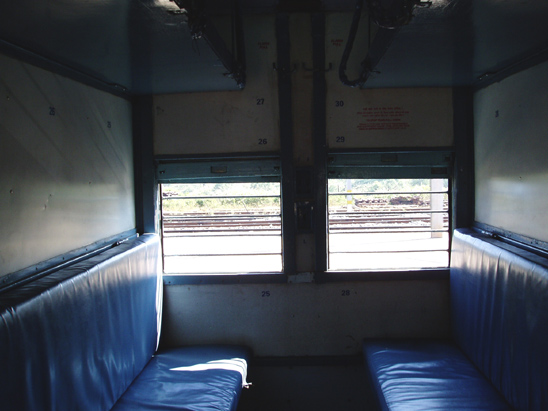
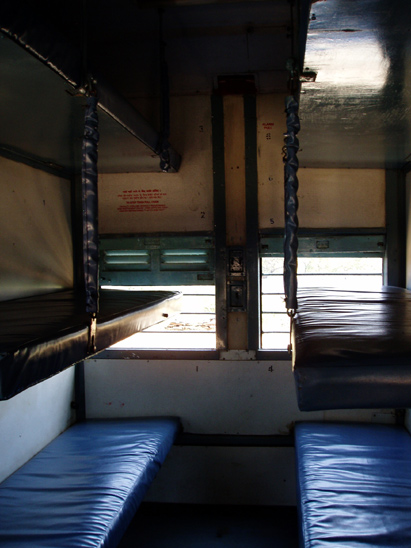
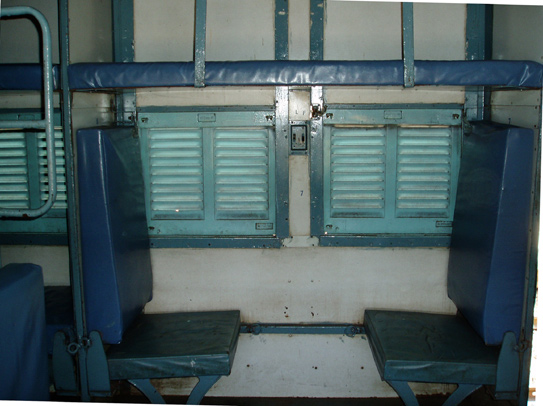
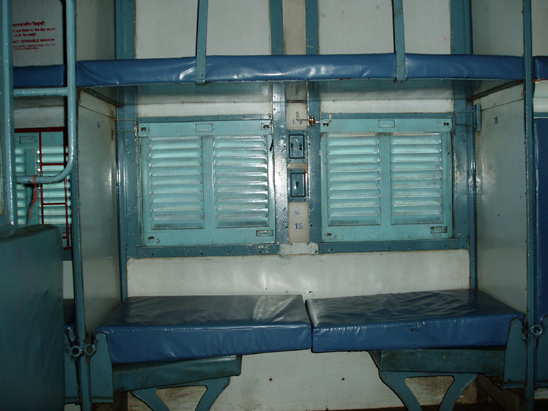
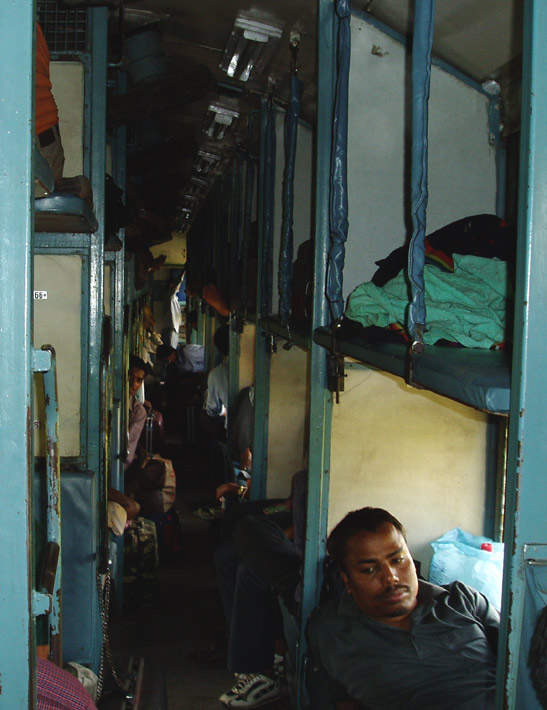
Anyway, back to my first ever overnight train ride. I failed to take any photos of our sleeper car (for reasons I will explain shortly), but some kind soul over at IndiaMike.com (a very good resource, by the way) posted these photos so that I may explain.

One side of the train car looks like this, with three people on each seat:


The pad that makes up the back of the seat lifts up and latches to the top berth, so that all three people have a bed:


On the other side of the train car, there are two single-person seats facing each other, with a single berth above:


The bottom seats fold down to make another berth:


When filled with people, it looks something like this:


And there you have it! Traveling sleeper class on a train in India is akin to flying first class on Singapore Airlines. Or not.

They do hand out "clean" sheets and pillows, but I had been warned and had packed my own.

Being a germaphobe (technically called a "mysophobe", thank you wikipedia) in India requires much planning and advance preparation, along with some creative packing skills (like bottles of hand sanitizer stashed in every compartment of every bag you have, a plastic bag containing a bar of soap for things like 16 hour train rides with no soap in sight, throw-away paper or fabric of any kind stashed everywhere for grabbing things like bathroom door handles and for covering your face when someone inevitably sneezes all over you without even the pretense of covering their mouth, etc.).

FYI: top berths are supposed to be the best in terms of people not being able to fall over onto you as they walk by. Just so you know. Because I know this post is making you so eager to take an overnight train through India.

Don't worry, it gets better.

About two hours into the trip, hubby complains he doesn't feel well. He climbs up onto my berth and puts his head in my lap to take a nap.

This is more complicated than it sounds.

I'd been relegated to my (top) berth because the guy on the bottom berth decided to lay down and go to sleep while I was gone to the bathroom. With nowhere else to sit, I had to climb on up. Since it was the side berth, there was a bit more space between me and the ceiling. Meaning you can sit with your back straight if you lean forward so that your head is in the aisle. If you hang your legs over the side, into the aisle, they're very much in the way for everyone walking past, so you have to sit with your legs crossed up on the seat. So I was sitting like this with a whole person draped across my lap. Comfy!

All that to say, this shit is not easy.

So hubby doesn't feel well, and then he goes and gets sick. Again and again and again. At one point I wondered if maybe he'd fallen off the train he was in the bathroom so long.

When he was finally able to make it back to his seat, pale and sweating, he said the words I had not realized I'd wanted to hear: "I think I understand now how miserable you were." (Referring to when I spent two weeks of our 2009 trip more sick than anyone should ever be in their life.)

Being sick at your stomach on a train is no easy thing. For one, you're on a moving vehicle which is rarely (if ever) helpful for an upset stomach. Two, you're sharing a bathroom with like a few dozen people, so you may have to wait your turn...no small feat when everything you've ingested in the past day is fighting to get out. Three, you have to use the toilet WHILE MOVING! I have enough issues with that on airplanes and you can hardly even tell. Four, it's a squat toilet. I challenge you to squat down, swaying from side to side (and front to back), and even just imagine trying to use the bathroom. Or vomit. It's enough to make you never want to leave your house again.

Thankfully, he only had to feel that miserable for one night. As luck would have it, his seatmates turned out to both be doctors and carrying around a ton of medicines. They loaded him up with drugs, I tucked him into his berth, and he passed out like a baby. After checking on him a few dozen times to make sure he was still breathing, I too went to sleep.

Sleeping on a train is really not all that bad. Or at least it's really not all that bad when you have your own sheet, your own pillow, ear plugs and a sleeping pill. I mean, if you have to go to the bathroom in the night you have to climb down a slippery ladder, find your shoes under the other guy's bed, walk down the aisle without falling over into anyone else's bed, go outside the car and use an f'ng squat toilet, hopefully remembering to bring your roll of tp and your bar of soap. But apart from that, it's easy peasy.

Now I just wrote a ridiculously long post on train travel. And frankly, just remembering it makes me tired. So this is all you get today. As always, in parting, I wish you love, peace and SOUL!

Friday, February 3, 2012

Dangerous to be a Girl

A friend posted this article from UK paper The Telegraph and I feel it's an important topic to address.

The article discusses a recently released United Nations report which states that India is the most dangerous place in the world to be born a girl, with females almost twice as likely to die before the age of five.

Another UN report (from 2009/2010) on achieving Millennium Development Goals (MDG) in the Asia-Pacific region states:
Girls have a biological advantage which should make them better able to survive the early years than boys. As a result, other things being equal, the ratio between the under-five mortality rates for girls and boys should be less than one – in Australia and New Zealand, for example, the ratios are 0.83 and 0.85, respectively. But in 16 countries in Asia and the Pacific the ratios are 0.99 or greater. The highest are in China (1.41), India (1.10), Pakistan (1.08), and the Federated States of Micronesia, Nepal and Tonga (1.07).
So, technically, more girls than boys should survive past the age of five. Yet in 2011, girls in India were nearly twice as likely than boys to die before the age of five.

The Telegraph article explains it this way:
Girls are widely regarded as a burden to Indian families who fear the high costs of their weddings and resent spending money on their education only for them later to leave the home to marry. 
A text written by the Ministry of Health and Family Welfare, Handbook on Pre-Conception and Pre-Natal Diagnostic Techniques Act, 1994 (PNDT) (the law against determining the sex) elaborates:
A pernicious form of violence against women in some parts of India has been and still is the elimination of the girl child or female infanticide. Various methods were found to eliminate the girl child after her birth like starving her, crushing her under the bed or giving her poison etc. Pertinently, the responsibility for killing the child was fixed on the woman/mother as she was considered responsible for bringing the girl child into existence.  
Exorbitant dowry demand is one of the main reasons for female infanticide. Some of the other reasons are the belief that it is only the son who can perform the last rites, lineage and inheritance runs through the male line, sons will look after parents in old age, men are the bread winners etc.
Census statistics show that India's sex ratio in 2011 was 914 girls per 1000 boys.

In contrast, according to the 2010 census, there are 967 men per 1000 women in the U.S.

According to the Handbook
Things have come to such a pass that in some villages of Madhya Pradesh, no marriages have taken place for years because there are no girls and the boys are married by buying girls from faraway villages of Bihar for paltry sums. In one district in west Rajasthan, in 1997, the first “baraat” was received after 110 years and in another clan, there are only two female surviving children compared to 400 male children...[in] Dang district of Rajasthan [there is] a woman living as the wife of eight brothers. 
Though the issue is widespread, and certainly does not always stick to a pattern, there is, statistically, a pattern.

The under-five mortality rate in India did decrease between 1995 and 2005. The infant mortality rate generally decreases as wealth increases. And a child whose mother has no education is less likely to survive to the age of five than a child whose mother has completed a full course of primary schooling.


In both 1995 and 2005, the mortality rate was higher in rural areas than in urban areas. And at both times the mortality rate for females was higher than males in rural areas, while the opposite was true in urban areas.

The MDG report states that
High mortality of girls in these subregions is often a reflection of patriarchal norms – which result, among other things, in strong patterns of son preference and the neglect of young girls. A recent study in India, for example,  found that girls were five times less likely than boys to be hospitalized for a childhood illness.
It should be said that some states in India, such as Kerala and Meghalaya, have matrilineal societies, where the importance of men and women is essentially reversed.

After marriage, the groom leaves his family to live with the bride's family. Property is passed down from mother to daughter. As with many languages, nouns have a gender, the difference here being that all "useful" things are feminine (ex: the word for tree is masculine, but when the wood is turned into any building material, the noun becomes feminine). The woman is revered as "the giver of all life". The men have power (there were no queens, only kings) -- but the right to that power is inherited from the women (the king's son cannot become king, only his sister's son).

In Thomas Laird's essay "A woman's world - Meghalaya, India; matrilineal culture," a professor at Shillong University describes the balance this way:
Women do not suffer here; we walk hand in hand with the man. We are not killed for our dowry, as happens too frequently in India. We are not forced to abort a fetus because of its sex, as happens too frequently in India and China. We are not forced into prostitution just because we want a divorce, as does still happen in village India. Here, in our world, women and men help each other in fact.
Unfortunately, these cultures are the exception rather than the rule.